Neural Amp Modeler: Replicating Iconic Metal Tones
Diving deep into Neural Amp Modeler (NAM) to capture and package some of the most legendary metal guitar tones into a free, accessible amp simulator.
As a musician and engineer, I've always been fascinated by the pursuit of the perfect guitar tone. The world of metal guitar has produced some of the most iconic, instantly recognizable sounds in music history—from the crushing low-end of Meshuggah to the searing leads of Metallica, the scooped mids of early Pantera, and the modern high-gain brutality of bands like Periphery and Architects.
Traditional amp modeling has come a long way, but Neural Amp Modeler (NAM) represents a paradigm shift. Instead of trying to recreate circuits through simulation, NAM uses deep learning to capture the actual sonic character of real amplifiers by learning from audio examples. The results are nothing short of remarkable.
What is Neural Amp Modeler?
Neural Amp Modeler is an open-source project that uses neural networks to create highly accurate digital recreations of guitar amplifiers, pedals, and other audio equipment. Unlike traditional modeling approaches that attempt to simulate the electrical behavior of circuits, NAM works by training a neural network on input/output audio pairs.
Here's the process: You feed a reference amplifier a series of test tones (sweeps, noise, and musical content), record both the input and output, and NAM's neural network learns the complex non-linear transformations that occur. The result is a model file that can replicate the amplifier's behavior with stunning accuracy—often indistinguishable from the original hardware.
Why NAM is Revolutionary for Tone Emulation
Unprecedented Accuracy
NAM models capture the subtle nuances that make each amplifier unique—the way it responds to pick attack, how it breaks up at different gain stages, the complex interactions between preamp and power amp sections, and even the character imparted by specific tubes and transformers.
Accessibility
What once required thousands of dollars in hardware can now be captured and shared as a relatively small model file. This democratizes access to legendary tones, making it possible for musicians at any level to experiment with sounds that were previously out of reach.
Preservation
As vintage amplifiers age and become increasingly rare and expensive, NAM provides a way to preserve their sonic character. A well-captured model can serve as a digital archive of irreplaceable gear, ensuring these tones remain accessible to future generations of musicians.
The Project: Iconic Metal Tones
My goal with this project is ambitious: to capture and replicate some of the most famous metal guitar tones in history. I'm talking about the tones that defined entire subgenres and influenced countless musicians.
The process involves meticulous research into the gear used on classic albums, acquiring or accessing the same amplifiers (when possible), and then carefully capturing them using NAM's training process. Each model requires hours of careful setup, recording, and training to ensure maximum accuracy.
But accuracy is just the beginning. The real challenge is understanding the full signal chain—not just the amp, but the guitars, pickups, cabinets, microphones, and even the room acoustics that contributed to those iconic sounds. Some of the most recognizable tones are the result of specific combinations that go far beyond just the amplifier.
The Nuances: What Makes NAM So Effective
Non-Linear Modeling
Traditional digital models often struggle with non-linear behaviors like tube saturation, transformer saturation, and speaker breakup. Neural networks excel at learning these complex, non-linear relationships because they're not constrained by simplified mathematical models.
Dynamic Response
One of NAM's greatest strengths is its ability to capture how an amplifier responds dynamically. The way an amp compresses when you dig in with your pick, how it cleans up when you roll back the volume, and how it responds to different playing styles—these are all captured in the model.
Frequency-Dependent Behavior
Real amplifiers don't respond uniformly across the frequency spectrum. NAM models learn these frequency-dependent behaviors, capturing how different frequencies interact with the amplifier's various stages. This is crucial for achieving authentic tone, especially in the complex frequency interactions found in high-gain metal tones.
Packaging for Accessibility
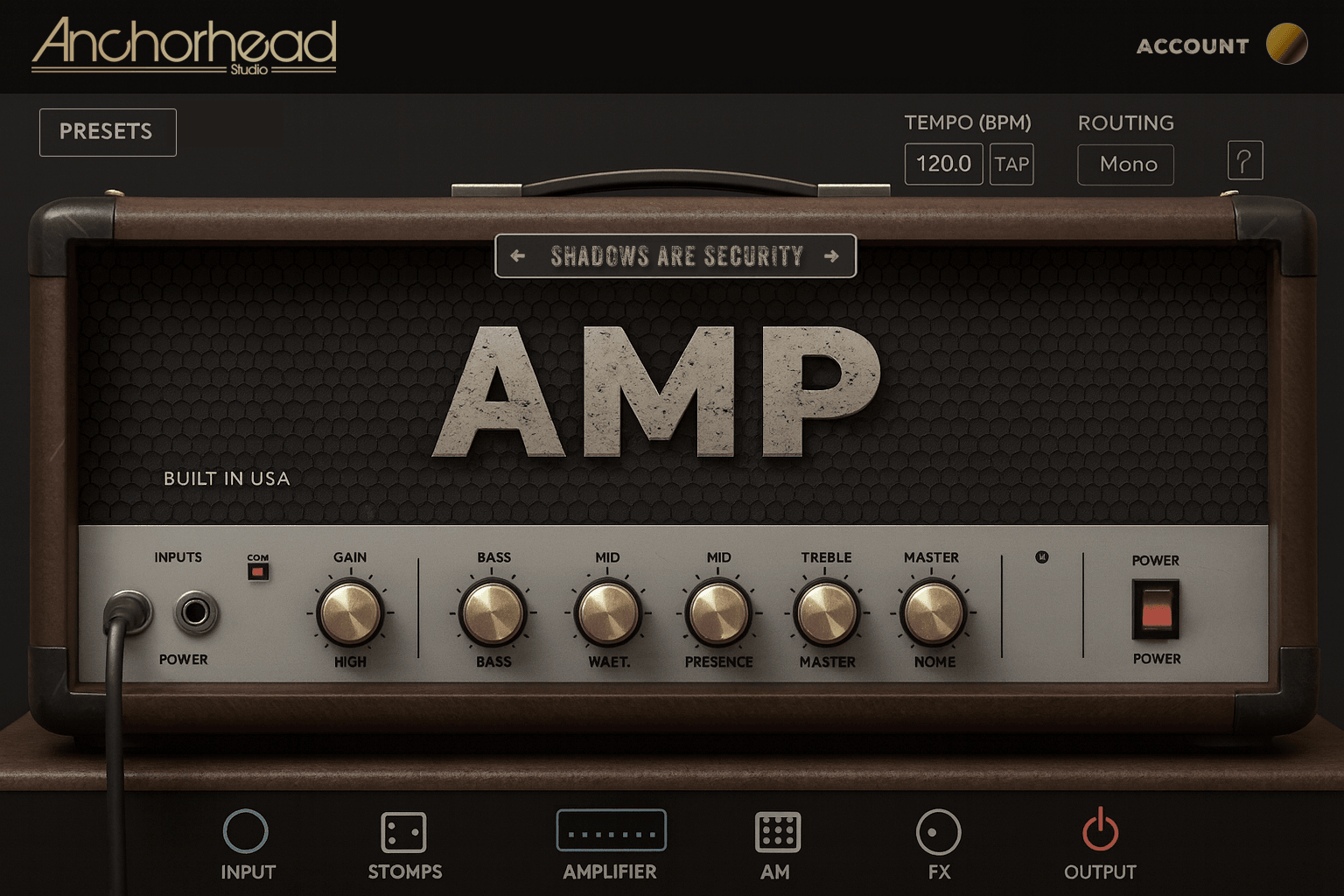
Creating accurate models is only half the battle. To make these tones truly accessible, I'm developing a custom amp simulator interface that packages these models in an intuitive, user-friendly format. The goal is to make it as easy as possible for musicians to access and use these iconic tones in their own work.
The interface you see in the mockup above represents my vision: clean, modern, and focused on the music rather than overwhelming technical options. Each model will include presets that replicate specific album tones, but also provide enough flexibility for users to dial in their own variations.
Available at Anchorhead Studio
This amp simulator will be available as a free download at www.anchorheadstudio.com — my music studio site where I house all my musical experiments and projects.
Anchorhead Studio is more than just a place to download amp sims. It's where I share my ongoing work in music technology, including:
- Almost 1:1 exact album drum tone replicas using Superior Drummer 3
- Mixing and mastering services for artists
- Various audio production tools and presets
- Documentation of my process and techniques
The goal is to create a resource for musicians and producers who, like me, are passionate about achieving authentic, professional tones without breaking the bank on vintage gear.
The Pursuit Continues
This project represents a convergence of my interests in music, technology, and engineering. Neural Amp Modeler has opened up possibilities that simply didn't exist a few years ago, and I'm excited to contribute to this growing ecosystem of accessible, high-quality tone modeling.
The work is ongoing. Each new model requires careful attention to detail, and the process of capturing and refining these tones is as much art as it is science. But the end goal is clear: making legendary metal tones accessible to anyone with a computer and a passion for creating heavy music.
Stay tuned for updates as I continue to add more models and refine the interface. The first release will include a curated selection of iconic metal tones, with more to follow based on community feedback and requests.