Background
Inventory Linker — Shopify App + Next.JS

Inventory Linker — Shopify App + Next.JS

Senior Shopify / Next.js Engineer

Shopify
Ecommerce
Automation
Next.js
Webhooks
Inventory Management
Real-time
Next.js
React
Shopify Admin API
Shopify GraphQL
Supabase
PostgreSQL
TypeScript
TailwindCSS
Webhooks

The Inventory Linker is a custom Shopify extension designed to solve a core operational challenge for Dwarven Forge: keeping inventory accurate across dozens of product variants that represent the same physical item. Many collections contain multiple listings, bundle configurations, or stylistic variants that all pull from a single shared stock. Without automation, updating each one manually is error-prone, slow, and guarantees inconsistencies during high-volume events. To eliminate this entire class of problems, I built a fully automated inventory engine that synchronizes linked Shopify variants in real time. Whenever any item in a defined group changes quantity—whether through an order, a manual inventory update, or an API adjustment—the engine recalculates the delta and updates every linked variant instantly and consistently.

Overview

The system operates on the concept of Inventory Groups: sets of Shopify variants that represent the same physical stock. Each group can contain two or more variants, and inventory for all members is always kept perfectly aligned. Behind the scenes, a custom webhook pipeline captures Shopify's inventory_levels/update events and triggers a synchronization cycle. The engine determines which group the change belongs to, identifies the master item for the event, reads its updated quantity, and applies the correct adjustments to every linked member. The result is a system that remains invisible to customers and staff while ensuring that inventory across complex product structures stays accurate down to the second.

Architecture

The inventory engine is designed for stability, speed, and clarity. Each part of the system has a single responsibility, and together they form a reliable real-time synchronization pipeline. Key architectural elements include: • Inventory Groups Model A normalized schema in Supabase maps Shopify inventory_item_ids into logical groups. Groups support any number of variants, enabling simple two-item links or large multi-variant product families. • Webhook-Driven Syncing Shopify sends real-time inventory_levels/update events for every quantity change. The app verifies signatures, reads the updated inventory item, locates its group, and initiates the synchronization cycle. • Master Item Resolution The system treats the variant associated with the webhook event as the temporary "master" for that cycle. Its quantity becomes the source of truth, and all peers in the group are synced to match. • Delta-Based Adjustments Instead of overwriting values blindly, the engine calculates the exact difference between the master quantity and each member's current quantity, then applies only the necessary adjustments via Shopify's GraphQL API. • Location-Aware Inventory Mapping All reads and writes target the correct Shopify location using GIDs, guaranteeing that fulfillment centers remain in sync even when merchants operate multiple inventory points. • Activity Logging Layer A built-in activity engine records syncs, webhook events, group updates, and structural changes, giving administrators a clear view into system behavior and history. Together, this architecture makes the engine robust, deterministic, and fully automated—ensuring accurate stock levels with zero ongoing manual work.

UI/UX

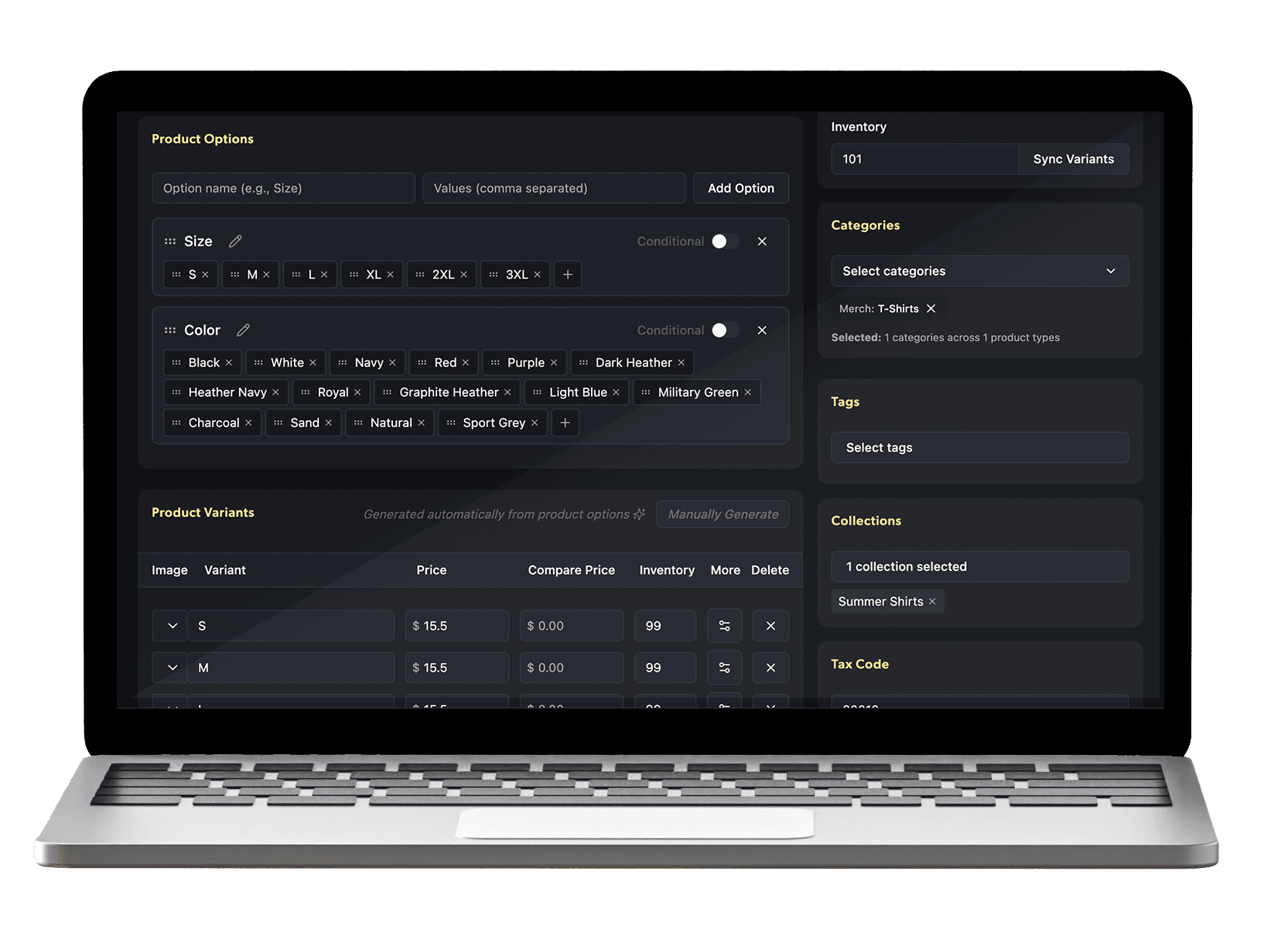
While most of the system runs automatically behind the scenes, the merchant-facing interface provides a clean, modern way to manage groups, inspect items, and monitor activity. The UI is designed to be intuitive for staff while still providing deep visibility for operations teams. UX highlights include: • Group Management Dashboard for creating and editing inventory groups, inspecting linked products, and triggering manual syncs when needed. • Folder organization that allows merchants to categorize and structure large inventories using a flexible many-to-many grouping system. • Search and filtering tools enabling instant navigation across large product catalogs. • Activity & Stats Panel with real-time indicators for total groups, items, and webhook activity throughout the day. • Recent activity feed showing sync events, item updates, group modifications, and webhook events, with timestamps and automatic refresh. • Modern card-based layout using product thumbnails, clean typography, badges, and responsive actions. The interface blends Shopify-native elements with custom UI components to create a fast, polished experience for managing complex variant relationships.

Challenges & Solutions

1. Keeping inventory consistent across multiple variants Shopify treats each variant as an independent inventory source. When multiple variants represent the same physical item, quantities quickly drift out of sync. Solution: Inventory Groups enforce a shared quantity model. Any change to a member triggers a synchronization cycle that updates all linked variants instantly. 2. Interpreting real-time webhook events safely Webhooks must be verified, parsed, and processed without delay to prevent race conditions or missed updates. Solution: The engine validates signatures using Shopify's HMAC system, processes events atomically, and logs each step to ensure reliable and traceable behavior. 3. Ensuring accurate updates at the correct Shopify location Merchants often use multiple Shopify locations, and syncing the wrong one would corrupt stock. Solution: All queries and mutations resolve against a configured SHOPIFY_LOCATION_ID, guaranteeing that reads and writes remain consistent across the entire platform. 4. Preventing cascading sync loops A naïve implementation could trigger additional webhooks with each update, creating an infinite sync chain. Solution: The system reads only the master's updated quantity and applies minimal deltas to members, avoiding redundant state changes and minimizing webhook noise. 5. Giving merchants clarity into automated behavior Automation without visibility creates uncertainty. Solution: A dedicated Activity Log and Stats Panel surfaces everything—syncs, webhook triggers, updates, group changes, and recent events—all in real time.

Impact

The Inventory Linker dramatically improves operational accuracy for Dwarven Forge's complex product ecosystem. What previously required constant manual checking and adjustments now happens automatically, reliably, and instantly. For staff, it reduces errors, prevents overselling, and removes the need to update multiple product listings individually. For customers, it ensures accurate stock availability across the storefront. For the system as a whole, it establishes a scalable model for handling shared inventory logic in Shopify environments that were never designed for it. The engine now serves as the backbone for Dwarven Forge's multi-variant catalog, ensuring stable, synchronized inventory across every touchpoint — from direct orders to API updates to high-traffic product launches.